The 12 Houses of Astrology, Explained Simply
Houses are where astrology stops being vague. What each of the twelve governs, how to read an empty one, and why two chart calculators can disagree.
Signs get all the attention. Houses do the actual work.
A planet's sign tells you the style of something. A planet's house tells you where in your life it happens, and that is usually the more useful half. Mars in Aries describes a certain kind of drive. Mars in Aries in the 7th house tells you it shows up in your relationships, which is information you can do something with.
This is a plain-English guide to all twelve houses: what each governs, what a planet there means, how to read an empty house, and why two different chart calculators can put the same planet in different places.
What houses are
The zodiac signs come from the Earth's orbit around the Sun, the Sun's apparent path through the year. The houses come from the Earth's rotation on its own axis over a single day.
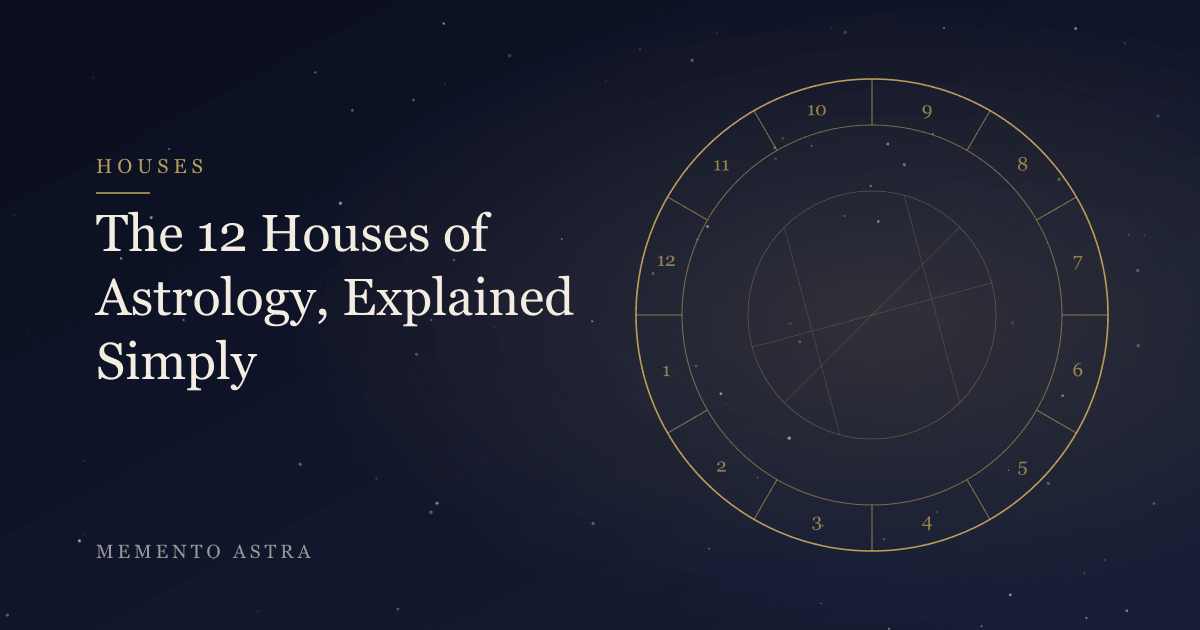
Picture the moment you were born. There is a horizon at your birthplace, and the sky is divided by it. The point rising on the eastern horizon is your Ascendant, and it marks the start of your 1st house. The wheel then divides into twelve segments running counter-clockwise.
Two consequences follow, and both matter:
- Houses need your birth time. No time, no houses. The whole layer is unavailable.
- Houses are personal in a way signs are not. Everyone born on your birthday shares your Sun sign. Almost nobody shares your house layout.
The four angles
Four house cusps carry special weight. They are the angles, and a planet close to one is amplified regardless of anything else in the chart.
| Angle | Position | Marks | Represents |
|---|---|---|---|
| Ascendant (AC) | Eastern horizon | 1st house cusp | Self, arrival, approach |
| Imum Coeli (IC) | Lowest point | 4th house cusp | Roots, home, the private base |
| Descendant (DC) | Western horizon | 7th house cusp | Others, partnership |
| Midheaven (MC) | Highest point | 10th house cusp | Public life, career, direction |
The AC-DC axis is me and you. The IC-MC axis is private and public. Between them they frame the entire chart. If you learn only four points in a wheel, learn these.
The twelve houses
1st house: Self
Body, appearance, first impressions, how you begin things.
The house of arrival. It describes the front you present and the instinctive way you approach anything new. Planets here are highly visible, other people notice them before you do.
A planet here: becomes a defining public feature. Saturn in the 1st reads as serious and self-controlled from childhood; Jupiter in the 1st reads as expansive and lucky.
2nd house: Resources
Money you earn, possessions, values, self-worth.
What you own and what you consider valuable, and, importantly, the two are linked. This house connects material security to the sense that you are worth something.
A planet here: shapes your relationship to earning and to security. Mars in the 2nd works hard for money and spends it fast; Venus in the 2nd wants comfort and beautiful objects.
3rd house: Communication
Speech, writing, learning, siblings, short journeys, immediate environment.
The everyday mind: how you take in information, how you express it, and the near world of neighbours, siblings, and local routine.
A planet here: colours how you think and talk. Mercury in the 3rd is its natural home: quick, verbal, endlessly curious.
4th house: Home and roots
Family, ancestry, the private self, where you come from and where you end up.
The base of the chart. It covers your childhood home, your family line, and the version of you that only exists in private. Traditionally it also covers the end of life, the final resting place.
A planet here: operates privately and is strongly tied to family. Moon in the 4th is doubly domestic; Uranus in the 4th often means a disrupted or unconventional upbringing.
5th house: Creativity and pleasure
Play, romance, children, self-expression, risk for its own sake.
The house of what you do for joy. Creative work, love affairs, children, gambling, performance, anything you do because you want to rather than because you must.
A planet here: finds expression through creativity or romance. Sun in the 5th needs an audience and a craft.
6th house: Work and routine
Daily work, service, health, habits, skill.
Not career. That is the 10th. This is the actual texture of your working day, the routines that hold your life together, and your physical health as a maintenance project.
A planet here: shows up in your daily rhythm. Virgo's natural house; Saturn here produces exceptional discipline and a tendency to overwork.
7th house: Partnership
Marriage, close partnerships, open enemies, contracts, the other.
Anyone you meet as an acknowledged equal: spouses, business partners, and, revealingly, declared opponents. Traditional astrology grouped them together for good reason.
A planet here: is experienced through other people, often projected onto them before it is owned. Mars in the 7th can mean a combative partner, or a person who only discovers their own assertion in relationship.
8th house: Death and transformation
Death, inheritance, shared resources, intimacy, crisis, the hidden.
The most misunderstood house in the wheel. Its unifying theme is what you cannot hold alone: death, other people's money, deep intimacy, and the transformations you do not choose.
A planet here: operates at depth and often through crisis. This is the house Memento Astra is built around. We cover it in full in The 8th House.
9th house: Meaning
Belief, philosophy, religion, higher education, long journeys, publishing.
Where the 3rd house gathers local information, the 9th builds it into a worldview. Faith, ideology, foreign places, and the search for a frame that makes things make sense.
A planet here: drives you toward meaning and distance. Jupiter's natural house.
10th house: Public life
Career, reputation, ambition, authority, what you are known for.
The top of the chart, and the most publicly visible point in it. Vocation rather than job. Also traditionally the parent who represented authority in your life.
A planet here: becomes part of your public identity, whether you intended it or not. Pluto in the 10th tends toward power, and toward reinventing a career from the ground up at least once.
11th house: Community
Friends, groups, networks, hopes, causes, the future.
Where the 10th is your individual standing, the 11th is your belonging: the groups you are part of, the causes you support, and what you want for the wider world.
A planet here: works through groups and collective aims. Aquarius's natural house.
12th house: The hidden
The unconscious, solitude, retreat, hidden things, endings, self-undoing.
The last house, and the strangest. It covers what is behind the scenes: dreams, the unconscious, institutions that remove you from ordinary life (hospitals, monasteries, prisons), and the patterns you cannot see in yourself.
A planet here: works quietly and is often invisible to its owner while obvious to everyone else. Sun in the 12th can mean a lifetime of not quite seeing yourself clearly.
Expert tip: houses come in pairs. Every house has an opposite, and the pair is a single axis rather than two topics. 1st/7th, self and other. 2nd/8th, mine and ours. 3rd/9th, information and meaning. 4th/10th, private and public. 5th/11th, personal joy and collective purpose. 6th/12th, routine and retreat. Reading a house without its opposite is like reading one side of an argument.
Angular, succedent, cadent
Houses are also grouped by strength: a classification that predates modern astrology and is still one of the most reliable interpretive tools.
| Type | Houses | Character |
|---|---|---|
| Angular | 1, 4, 7, 10 | Strongest. Action, initiation, high visibility. |
| Succedent | 2, 5, 8, 11 | Stabilising. Consolidates what the angular houses start. |
| Cadent | 3, 6, 9, 12 | Adaptive. Processes, learns, prepares, transitions. |
A chart with several planets in angular houses describes someone whose life happens outwardly. A cadent-heavy chart describes someone whose life happens in thought, preparation, and adjustment. Neither is better; they are different tempos.
Reading empty houses
Ten planets, twelve houses. At least two of your houses are empty, and that is completely normal. An empty house does not mean an absent area of life: most people with empty 7th houses still get married.
To read one:
- Find the sign on the house cusp.
- Find that sign's ruling planet.
- Find where that planet sits.
Empty 7th house with Sagittarius on the cusp, and Jupiter in your 9th? Then partnership plays out through shared beliefs, travel, or study. You meet people through what you are exploring rather than through daily proximity.
The house is never empty. Its business is being run from another address.
Why house systems disagree
This is where beginners lose confidence, so it is worth stating plainly: astrologers do not agree on how to divide the wheel, and different methods put planets in different houses.
The main contenders:
| System | Method | Notes |
|---|---|---|
| Placidus | Divides by time taken to rise | The modern default; most software shows this. Unequal houses. Breaks down at extreme latitudes. |
| Whole Sign | Each sign = one house | The Hellenistic original. Strongly revived since the 1990s. Simple and robust everywhere. |
| Equal | 30° each from the Ascendant | Keeps the AC as 1st cusp but detaches the MC from the 10th. |
| Koch, Campanus, Regiomontanus | Various geometric divisions | Used by specific schools and traditions. |
The disagreement is real and unresolved. A planet at 28° Leo can be 10th house in Placidus and 11th in Whole Sign, and the two readings differ substantially.
A practical position: start with Whole Sign if you are learning, because it is unambiguous and historically grounded. Then look at your chart in Placidus and see which one describes your life better. Most working astrologers eventually settle on one and note where the other disagrees. Nobody has proved either correct, and pretending otherwise is not useful to you.
Common myth: "The house system doesn't matter." It does. For roughly a third of charts, the two most common systems produce meaningfully different placements, especially for people born at higher latitudes, where Placidus houses become badly distorted. If a placement in your chart feels wrong, checking the house system is the first thing to try.
How to read your houses
- Cast your chart with an accurate birth time.
- Find your Ascendant. Everything counts counter-clockwise from there.
- Note which houses have planets. These are your loud areas.
- Look at the angular houses first: 1, 4, 7, 10. Planets there dominate.
- Find your stelliums. Three or more planets in one house makes that area of life a defining preoccupation.
- Note the empty houses, then find their cusp rulers.
- Read each occupied house as a sentence: planet (what) + sign (how) + house (where).
Frequently asked questions
What if I don't know my birth time? You cannot calculate houses without it. You will still get accurate sign placements for every planet except possibly the Moon. Cast for noon and treat the chart as a partial reading, real, but missing a layer.
Can a house have more than one sign in it? In Placidus and most quadrant systems, yes: a large house can contain an entire sign with no planets in it. That sign is called intercepted, and the tradition reads it as an area of life that takes longer to access or express. In Whole Sign houses, interceptions do not occur.
What's the difference between the 6th and 10th houses? The 6th is the work you do; the 10th is what you are known for. A nurse's daily rounds are 6th house; their professional standing and vocation are 10th.
Which house is the "worst"? None. The 6th, 8th, and 12th were classically called cadent and unfortunate, and that framing has largely been dropped for good reason. They are the houses that deal with difficulty, which is not the same thing as being bad.
What is a stellium? Three or more planets in a single house or sign. It concentrates the chart heavily into that area of life, usually to a degree that is obvious to everyone except its owner.
How do houses work in a death chart? Identically in mechanics, differently in meaning. A death chart is cast for the moment of death rather than birth, so the houses describe the frame around an ending rather than a life's arenas. The 4th house (endings, the final resting place) and the 8th (death itself) tend to carry the most weight.
Next steps
- Cast your birth chart: with your birth time, for the full house layout.
- What Is a Birth Chart?: the complete beginner's guide.
- The 8th House: the one everybody asks about.
- What Is a Rising Sign?: the placement that sets all twelve houses.
- What Do the Planets Mean?: the what that goes in each where.
- How to Read Your Birth Chart: the order to put it all together in.
Signs tell you the flavour. Houses tell you the address. Astrology only becomes specific when you have both.